Transforming the traditional nutrient removal approach to nutrient recovery and valorization and contaminant removal through photo-bio-electrochemical and membrane technologies
An international project coordinated by Universitat Politècnica de València, funded under Horizon Europe Water4All Partnership 2024
Understanding the Global Challenge
Nutrient recovery
Millions of tons of nutrients are present in wastewater, while most treatment facilities do not recover them.
Contaminant removal
Contaminants of emerging concern (including pharmaceuticals, pesticides and PFAS) threaten water security and are not efficiently removed by conventional water treatments.
Minimal chemical addition
ReWAdd generates acids and alkali directly from wastewater itself, eliminating the need for external reagents.
The ReWAdd Solution
ReWAdd develops integrated process schemes that extract, concentrate, and transform nutrients into marketable added-value products — with minimal chemical addition.
By combining photo-bio-electrochemical and membrane technologies, ReWAdd creates a new generation of treatment systems that simultaneously:
- Recover phosphorus and nitrogen as fertilisers (struvite, ammonium phosphate)
- Generate microbial protein for animal feed using Power-2-Protein technology
- Produce acids and alkali directly from the wastewater itself
- Eliminate contaminants of emerging concern (pharmaceuticals, pesticides, PFAS)
- Deliver clean water safe for reuse or discharge
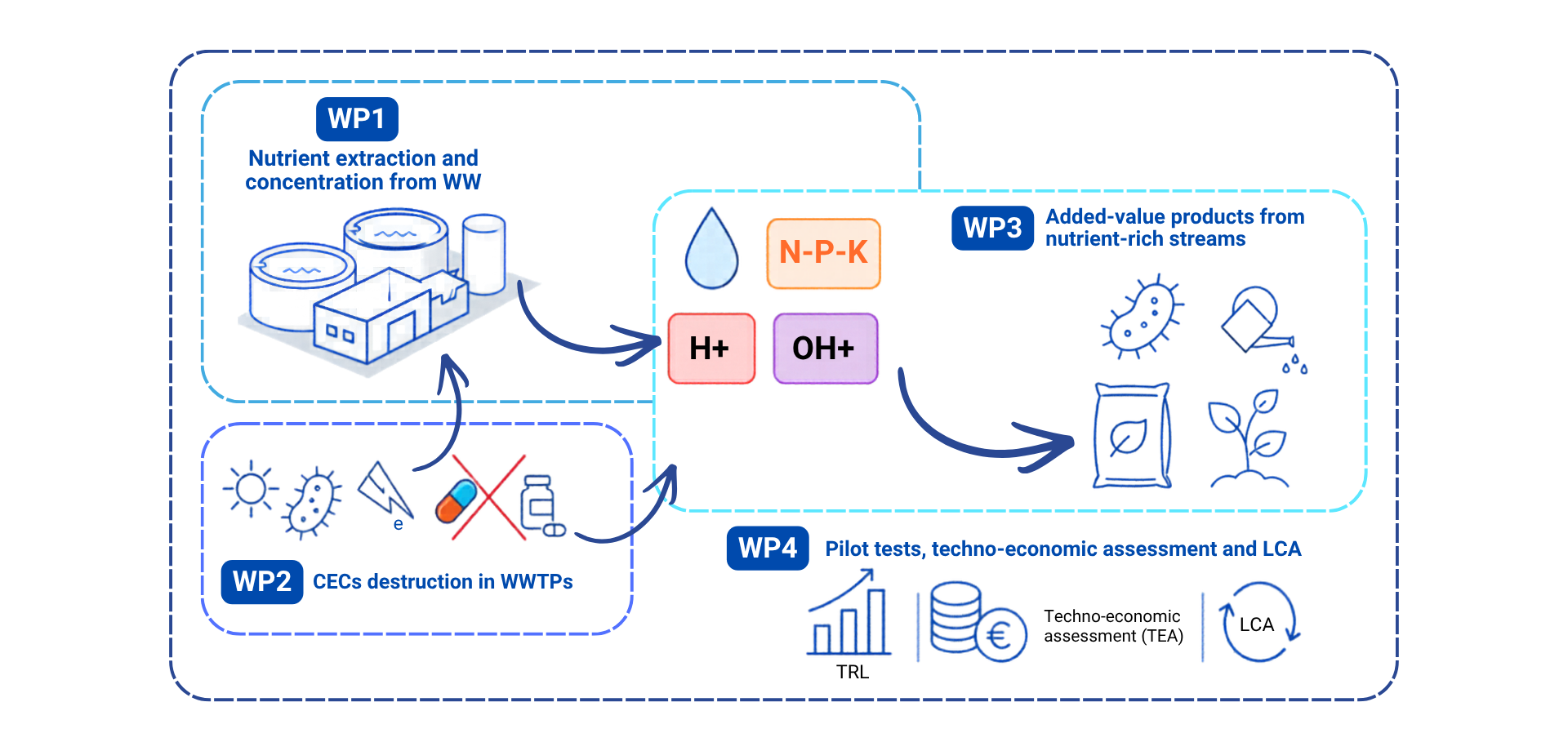
The approach works with four types of streams: primary and secondary effluents, liquid fractions of anaerobic digestate, and food industry wastewater. In all cases, the principle remains the same: minimum chemicals in, maximum value out.
Project Objectives
ReWAdd addresses three specific objectives that define the project’s scientific scope and ambition:
SO1 | Integrated nutrient recovery
Develop process schemes that extract nutrients from wastewater, concentrate them efficiently, and transform them into marketable added-value products including fertilisers, microbial protein, and clean water.
SO2 | Complete contaminant removal
Ensure the destruction of contaminants of emerging concern preventing their presence in product streams and avoiding their accumulation in the environment.
SO3 | Circular treatment approach
Implement processes with minimal or zero chemical addition and minimal secondary waste generation, increasing the circularity of water treatment facilities and reducing their environmental footprint.
Contributing to Global Goals
ReWAdd directly contributes to four UN Sustainable Development Goals.
The project is strategically aligned with the new Urban Wastewater Treatment
Directive (UWWTD 2024/3019), which sets ambitious targets for nutrient recovery and energy neutrality in treatment plants serving over 150,000 person equivalents by 2045. ReWAdd technologies operate at room temperature, minimise reagent addition, and can be powered by renewable energy sources — directly addressing the Directive’s circularity and climate neutrality requirements.
SDG 6 (Clean Water and Sanitation)
Advanced contaminant removal ensuring safe water discharge and reuse.
SDG 14 (Life Below Water)
Nutrient recovery preventing eutrophication in coastal and marine ecosystems
SDG 12 (Responsible Consumption and Production)
Circular approach transforming waste streams into valuable resources.
SDG 15 (Life on Land)
Clean water discharge protecting terrestrial water bodies and groundwater
How ReWAdd Works: Six Interconnected Work Packages
WP1. Nutrient Extraction and Concentration
WP1 establishes the foundation of ReWAdd by developing membrane technologies for selective nutrient extraction and concentration. The work package combines pressure-driven (nanofiltration, reverse osmosis) and electrically-driven (electrodialysis) membrane processes to maximise nutrient recovery from different wastewater sources.
The team evaluates membrane materials for optimal selectivity, optimises operating conditions for minimum energy consumption, and develops synergistic coupling strategies. Target concentrations of 500 mg-N/L and 60 mg-P/L are achieved for subsequent fertiliser production, while ensuring the treated water meets the new UWWTD discharge standards.
Key innovation
Two-stage membrane processes where nutrient-rich solutions from pressure-driven systems are further concentrated by electrodialysis, exploiting higher ionic conductivity for improved energy efficiency.
How ReWAdd Works: Six Interconnected Work Packages
WP2. Contaminant Destruction Technologies
WP2 ensures the complete destruction of contaminants of emerging concern (CECs) including pharmaceuticals, pesticides, and PFAS compounds that conventional treatment cannot address. The work package develops advanced oxidation processes tailored to different stream characteristics.
For high-salinity streams, electrochemical advanced oxidation processes using boron-doped diamond and custom ceramic Sb-doped SnO₂ anodes achieve complete mineralisation. For low-salinity streams, DTU’s innovative bio-solar photoelectrochemical system integrates microbial H₂O₂ synthesis with photocatalysis.
Performance target
Over 85% CEC removal efficiency, exceeding the requirements established in the new Urban Wastewater Treatment Directive for advanced treatment.
How ReWAdd Works: Six Interconnected Work Packages
WP3. Added-Value Product Generation
WP3 transforms the nutrient-concentrated streams from WP1 into high-value marketable products using two parallel approaches: biological protein production and electrochemical fertiliser generation.
How ReWAdd Works: Six Interconnected Work Packages
WP4. Real-World Validation
WP4 bridges the gap between laboratory research and real-world application by conducting comprehensive techno-economic and environmental assessments alongside pilot-scale demonstrations in industrial and urban environments.
Real-environment testing
Pilot tests will be conducted with industrial effluents in Germany and with urban wastewaters at the València Urban Sandbox, providing data on technical feasibility, process stability, and economic performance under realistic conditions.
Life Cycle Assessment
Comprehensive LCA following ISO 14040/14044 standards evaluates environmental impacts of each added-value product, considering material criticality, energy consumption, product value, and environmental issue mitigation.
TRL advancement
The work package elevates ReWAdd technologies from experimental proof of concept (TRL3) to technology validated in relevant environment (TRL5), preparing the foundation for commercial deployment.